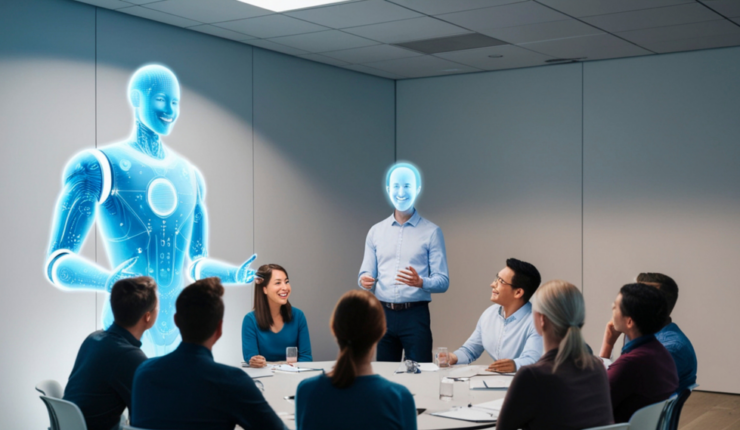
Is AI going to be measured in Person Power?



One of the best parts of my role at Digital Leaders is the sheer number of fascinating people I get to meet each week from across our community.
The generosity of that community is striking. We make everything free at the point of use, and in return people consistently offer their insights, experiences, and hard-won lessons with an openness that asks for nothing back. It’s one of the things that makes Digital Leaders so special.
So today, when I met a colleague and our conversation quickly turned to the speed at which AI is evolving, we found ourselves swapping stories. Between us, we had gathered a week’s worth of anecdotal examples of how organisations are experimenting with AI — the successes, the frustrations, the unexpected outcomes, and the real uncertainty about what comes next.
As we talked, we began to wonder: what would a historian of the Industrial Revolution make of all this?
Back in the 1780s, society was undergoing a different kind of technological upheaval. Communities shifted rapidly. People moved into cities. Work became centred around factories rather than farms. Entirely new industries emerged, and a new class of entrepreneurs accumulated wealth at unprecedented speed.
New business models must have been created almost overnight. Innovators would have searched for ways to incorporate steam power into existing processes, and huge sums would have been invested — and lost — before the right approaches to scale and profitability were understood.
In many ways, it sounds very familiar.
And one story from that first Industrial Revolution feels particularly relevant as we try to make sense of today’s AI moment.
In 1782, the Scottish engineer and inventor James Watt introduced the concept of horsepower. His goal was simple: to compare the output of his improved steam engines with something his potential customers already understood — the working power of horses.
Watt calculated that a horse could lift 33,000 pounds one foot in one minute, and he established this as the standard unit of one horsepower.
What’s most interesting, though, is why he did it.
It wasn’t purely an engineering breakthrough. It was marketing.
Watt needed a way to help Mine owners and Mill operators do the maths. These customers were used to paying for horses, feeding them, training them, replacing them. “Horsepower” gave them a familiar benchmark for understanding return on investment.
So if the marketing teams of the Industrial Revolution came up with “horsepower” to help businesses justify steam engines, what will the modern equivalent be for AI?
How will organisations be helped to calculate the ROI of investing in these new systems?
I personally shudder at the thought, but will it be something like “Person Power”?
Will AI in the near future be sold, assessed, and compared using a standardised figure that represents the work capacity of a certain number of people — allowing accountants and executives to slot AI neatly into cost-benefit spreadsheets alongside everything else?
Thinking back to my conversation with my colleague — and to the wider discussions we’ve been having across the Digital Leaders community — one theme keeps surfacing.
AI investment is increasingly being linked to reduced hiring.
In particular, we are hearing stories of fewer graduate roles in large professional firms, and similar patterns emerging across other sectors too. Organisations sense that AI will change workforce needs, but many still have only a broad understanding of how to measure those staff cost implications in any meaningful way.
I’m not yet aware of a modern-day James Watt sitting down to calculate the “Personpower” of a given AI model — but it feels like something that must be just around the corner.
And while I am no historian, I suspect that when businesses first adopted Watt’s steam engines, the immediate impact was a decline in demand for young horses being trained for work.
But I can’t help wondering whether the older horses saw what the future held.
Read More Workforce & AI Skills