
Where do your employees’ prompts actually go?
October 2026



Every AI model you use comes in one of two forms, and the difference decides where your data goes. There are closed models and there are open models.
With a closed model you never touch the model itself. You send a question to the company’s servers and an answer comes back.
With an open weights model the company hands you the model to run yourself: the full set of settings that make it work, everything it learned in training, in a file you can download. Those settings are called the weights, and they are the model. Copy them and you have copied it.
So, the whole question is this. Does the company let you have the weights, or does it keep them and let you talk to the model only through its own service?
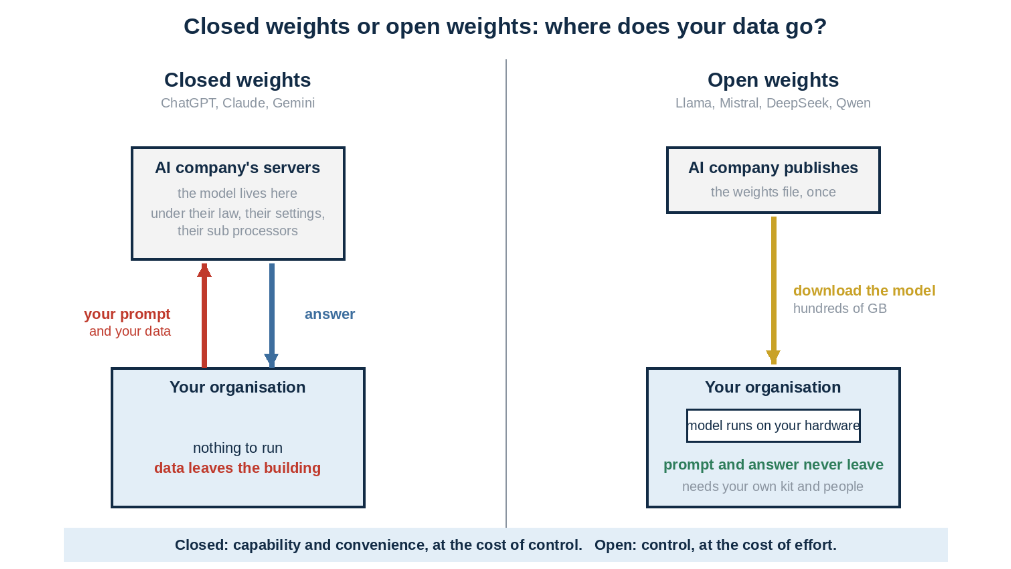
Closed weights or open weights: where your data goes
Closed weights means the numbers stay with the company. This is how ChatGPT, Claude and Gemini work. You send your question over the internet, the model runs on their servers, and the answer comes back. The company controls everything: which version you get, what it will refuse to answer, what it costs, what happens to your data on the way through, and whether the model exists at all next year. In return you get the most capable models available, no hardware to buy or run, and someone else’s problem when it breaks. For most everyday work that is a good trade.
Open weights means the company publishes the numbers. Meta’s Llama, Mistral from France, and DeepSeek, Qwen and Kimi from China are the best known. You download a folder of files containing nothing but the weights, plus a small file describing the shape of the network they belong to. There is no program in the download and nothing to double click. Free software such as Ollama reads the small file, builds the network in memory and loads the weights into it. Then you need a machine that can hold it all at once, and this is the catch. The largest open models will not run on an ordinary laptop or office PC. They need specialist graphics cards costing thousands of pounds each, or a rented server with them fitted. Smaller versions will run on a good laptop and are useful, but they are not as capable as the full models. Most organisations start with a smaller model on a modest server, prove it works on one sensitive task, and scale up from there.
Once that is done the picture changes completely. Your data never leaves your building. You can run the model without an internet connection, adapt it to your own data, and keep using it long after the maker has moved on to something else. With the model on your own hardware, no provider sees your prompts, no other company handles them, and no foreign court can order anyone to hand over data that only you hold. Compare that with the closed route. A European server from an American provider does not protect you, because the order follows the company, and since 2022 even a British provider can receive an American order directly. Running open weights yourself is the one arrangement that avoids both.
For an organisation the choice is less about ideology than about where your data can go and what you can afford. If the work is ordinary, drafting, summarising, answering emails, and nothing in it would hurt you if a foreign court saw it, closed is the sensible default. If the work involves patient records, client files, unreleased financials or anything a regulator cares about, open weights on hardware you control is the only way to be certain the data stays with you, and a rented server in a British data centre gets you most of the way. For a smaller model that can cost a few hundred pounds a month; the largest models cost considerably more.
So, which is better? Neither, and anyone who tells you otherwise is selling one of them. Closed buys capability and convenience at the cost of control. Open buys control at the cost of effort. Most organisations end up with both, a closed model for the everyday and an open one behind the firewall for the sensitive. The question to ask is not which model is best. It is which of your data you could stand to lose control of, and let that decide where each job goes.
October 2026

September 2026

September 2026